
MASTER HARDNESS TEST BLOCKS
We provide high-precision master hardness test blocks for every hardness scale, including ILAC MRA certification by ANAB ISO/IEC 17025, to ensure daily and continuous accuracy on your hardness testers. They are available in all Rockwell, Brinell, Vickers, and Knoop scales. Choose AFFRI Inc. for precise, certified specimens that meet the highest standards.
CERTIFICATE NUMBER: AC-3026

MASTER HARDNESS TEST BLOCKS
We provide high-precision master hardness test blocks for every hardness scale, including ILAC MRA certification by ANAB ISO/IEC 17025, to ensure daily and continuous accuracy on your hardness testers. They are available in all Rockwell, Brinell, Vickers, and Knoop scales. Choose AFFRI Inc. for precise, certified specimens that meet the highest standards.
CERTIFICATE NUMBER: AC-3026
Certified Precision Master Test Blocks for Hardness Instrument Calibration
ATI Laboratory Accredited ISO/IEC 17025
Affri Testing Instruments Laboratory is ANAB ISO/IEC 17025 accredited with certificate no. AC 3026, and offers high-precision certified test blocks for the calibration and verification of hardness testers, ensuring full compliance with international ISO and ASTM standards. Our certified test blocks cover all hardness scales, including Rockwell, Brinell, Vickers, and Knoop, and are available in a wide range of values to meet the diverse calibration needs of our customers.
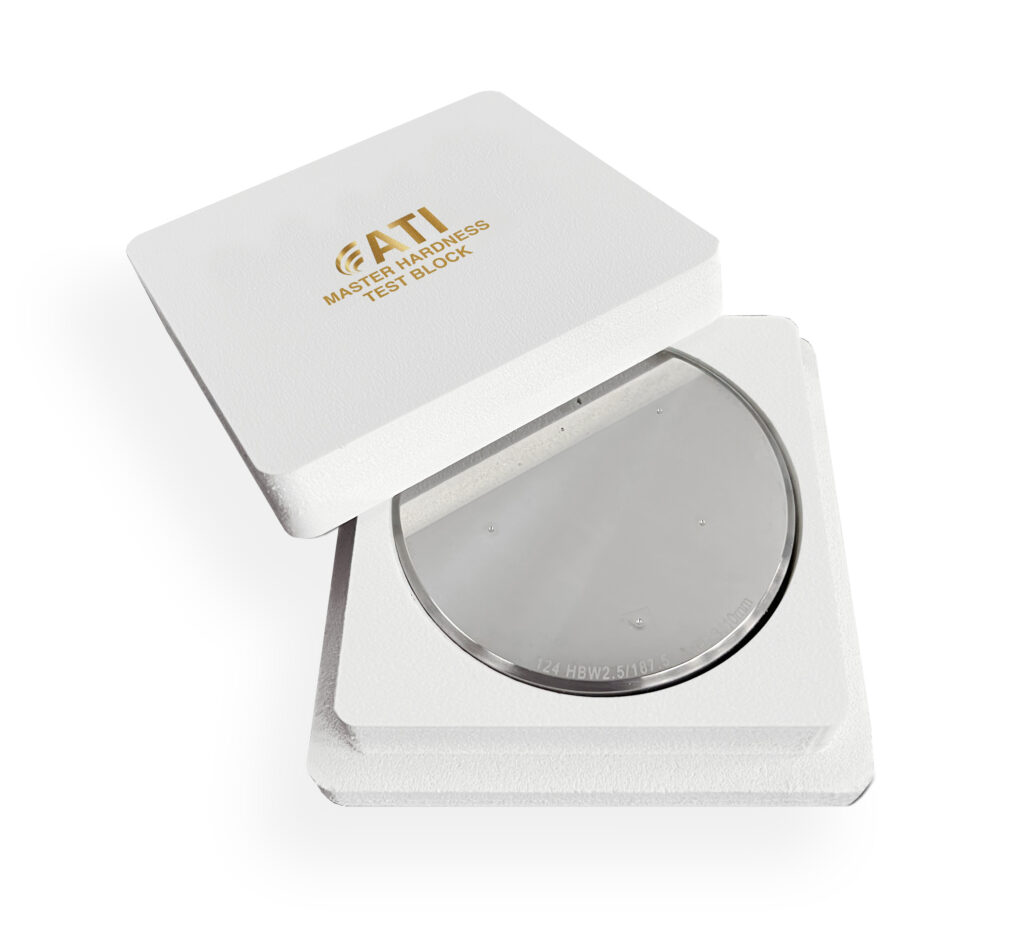
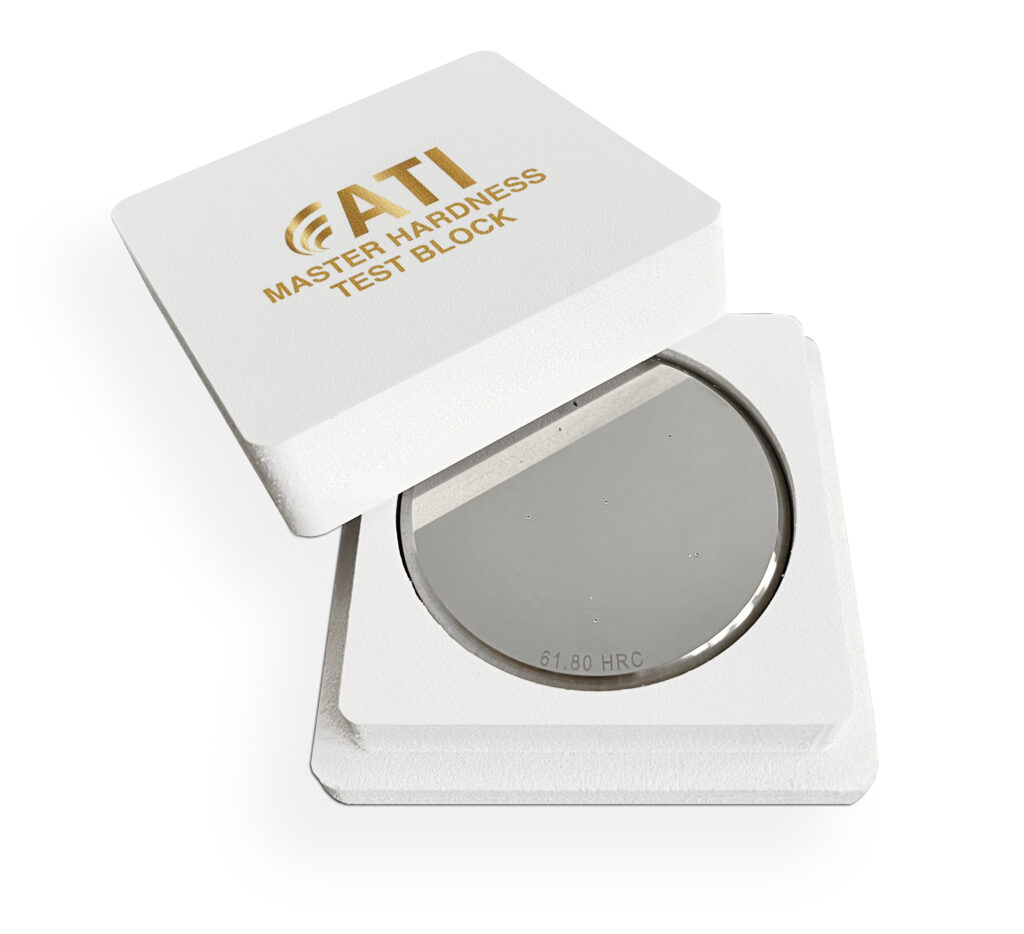
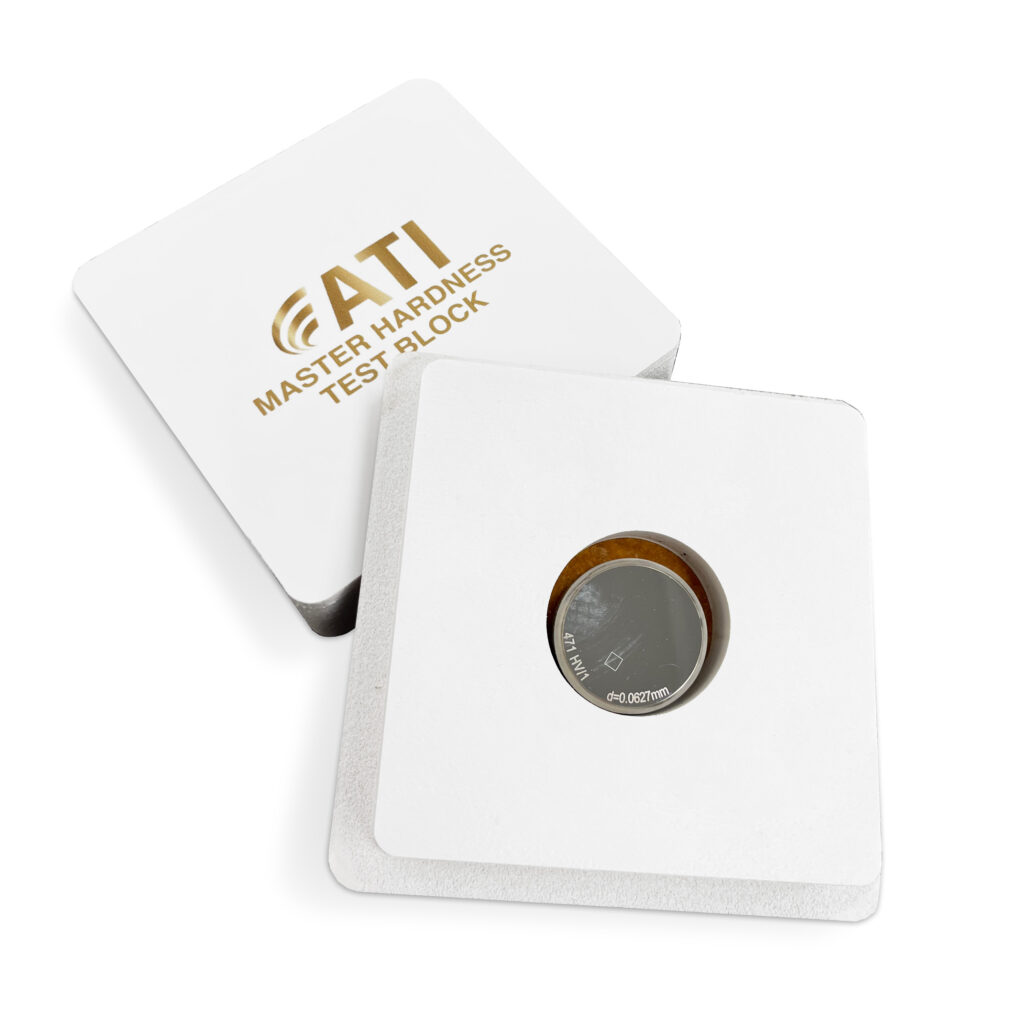
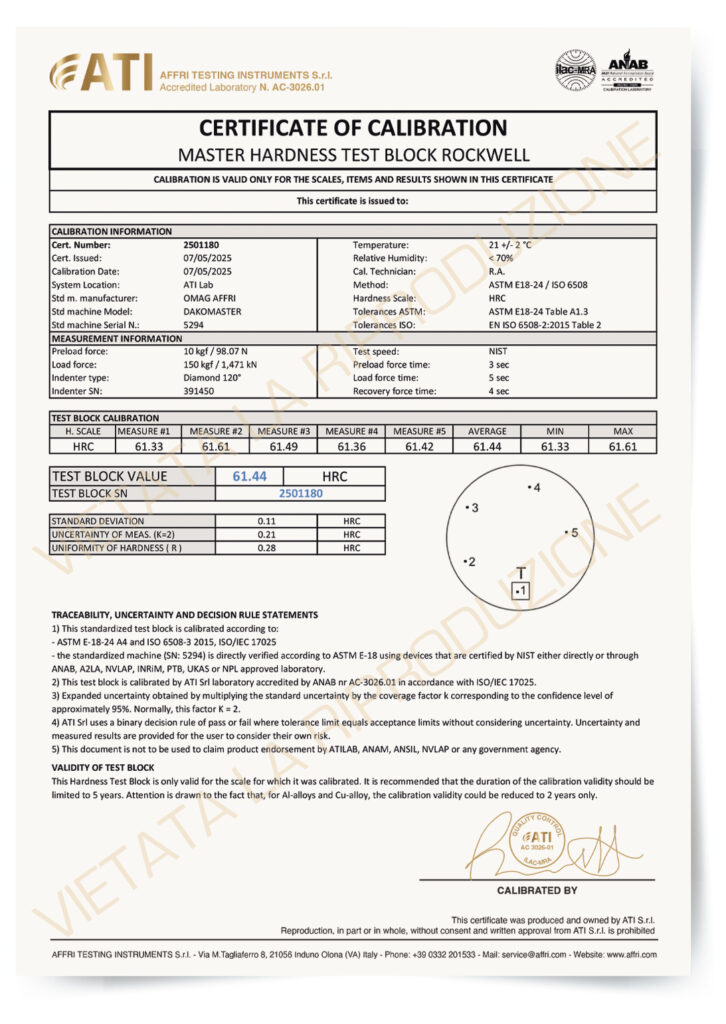
CERTIFIED PRECISION MASTER TEST BLOCKS
FOR HARDNESS INSTRUMENT CALIBRATION
Affri Testing Instruments Laboratory is ANAB ISO/IEC 17025 accredited with certificate no. AC 3026, and offers high-precision certified test blocks for the calibration and verification of hardness testers, ensuring full compliance with international ISO and ASTM standards. Our certified test blocks cover all hardness scales, including Rockwell, Brinell, Vickers, and Knoop, and are available in a wide range of values to meet the diverse calibration needs of our customers.
ATI Laboratory Accredited ISO/IEC 17025
Rockwell
- Rockwell
| Hardness Scale | Hardness Range | Size mm with mirror surface | Weight |
|---|---|---|---|
| HRA | 20 < HRA < 40 | Ø 60X10 mm | 0,2 kg |
| 45 < HRA < 75 | Ø 60X10 mm | 0,2 kg | |
| 80 < HRA < 84 | Ø 60X10 mm | 0,2 kg | |
| HRB | 20 < HRB < 50 | 50X50 mm** | 0,2 kg |
| 60 < HRB < 70 | 60X40 mm | 0,2 kg | |
| 88 < HRB < 100 | 60X40 mm | 0,2 kg | |
| HRC | 20 < HRC < 30 | Ø 60X10 mm | 0,2 kg |
| 35 < HRC < 55 | Ø 60X10 mm | 0,2 kg | |
| 60 < HRC < 70 | Ø 60X10 mm | 0,2 kg | |
| HRD* | 40 < HRD < 47 | Ø 60X10 mm | 0,2 kg |
| 55 < HRD < 63 | Ø 60X10 mm | 0,2 kg | |
| 70 < HRD < 75 | Ø 60X10 mm | 0,2 kg | |
| HRE | 95 < HRE < 100 | Ø 60X10 mm | 0,2 kg |
| 107 < HRE < 114 | Ø 60X10 mm | 0,2 kg | |
| HRF | 105 < HRF < 114 | Ø 60X10 mm | 0,2 kg |
| HR15N | 70 < HR15N < 77 | Ø 60X10 mm | 0,2 kg |
| 78 < HR15N < 88 | Ø 60X10 mm | 0,2 kg | |
| 89 < HR15N < 91 | Ø 60X10 mm | 0,2 kg | |
| HR30N | 42 < HR30N < 54 | Ø 60X10 mm | 0,2 kg |
| 55 < HR30N < 73 | Ø 60X10 mm | 0,2 kg | |
| 74 < HR30N < 80 | Ø 60X10 mm | 0,2 kg | |
| HR45N | 20 < HR45N < 31 | Ø 60X10 mm | 0,2 kg |
| 32 < HR45N < 61 | Ø 60X10 mm | 0,2 kg | |
| 62 < HR45N < 70 | Ø 60X10 mm | 0,2 kg | |
| HR15T | 77 < HR15T < 80 | Ø 60X10 mm | 0,2 kg |
| 80 < HR15T< 83 | Ø 60X10 mm | 0,2 kg | |
| 88 < HR15T < 93 | Ø 60X10 mm | 0,2 kg | |
| HR30T | 49 < HR30T < 56 | Ø 60X10 mm | 0,2 kg |
| 57 < HR30T < 63 | Ø 60X10 mm | 0,2 kg | |
| 73 < HR30T < 82 | Ø 60X10 mm | 0,2 kg | |
| HR45T | 23 < HR45T < 33 | Ø 60X10 mm | 0,2 kg |
| 34 < HR45T < 43 | Ø 60X10 mm | 0,2 kg | |
| 58 < HR45T < 72 | Ø 60X10 mm | 0,2 kg |
**HRB (20<HRB<50) has squared shape
*These master hardness test blocks are subject to availability
Brinell
- Brinell
| Hardness Scale | Hardness Range | Size mm with mirror surface | Weight |
|---|---|---|---|
| HBW 10/3000 | 150 < HBW < 225 | Ø 90X17 mm | 0,8 kg |
| 225 < HBW < 350 | Ø 90X17 mm | 0,8 kg | |
| 350 < HBW < 650 | Ø 90X17 mm | 0,8 kg | |
| HBW 10/1500* | 150 < HBW < 225 | Ø 90X17 mm | 0,8 kg |
| 225 < HBW < 350 | Ø 90X17 mm | 0,8 kg | |
| 350 < HBW < 650 | Ø 90X17 mm | 0,8 kg | |
| HBW 10/1000 | 75 < HBW < 150 | Ø 90X17 mm | 0,8 kg |
| 150 < HBW < 300 | Ø 90X17 mm | 0,8 kg | |
| 300 < HBW < 450 | Ø 90X17 mm | 0,8 kg | |
| HBW 10/500 | 75 < HBW < 150 | Ø 90X17 mm | 0,8 kg |
| 150 < HBW < 300 | Ø 90X17 mm | 0,8 kg | |
| 300 < HBW < 450 | Ø 90X17 mm | 0,8 kg | |
| HBW 10/250* | 75 < HBW < 150 | Ø 60X10 mm | 0,2 kg |
| 150 < HBW < 300 | Ø 60X10 mm | 0,2 kg | |
| 300 < HBW < 450 | Ø 60X10 mm | 0,2 kg | |
| HBW 10/100* | 75 < HBW < 125 | Ø 60X10 mm | 0,2 kg |
| HBW 5/750 | 100 < HBW < 225 | Ø 90X17 mm | 0,8 kg |
| 225 < HBW < 350 | Ø 90X17 mm | 0,8 kg | |
| 350 < HBW < 650 | Ø 90X17 mm | 0,8 kg | |
| HBW 5/250* | 75 < HBW < 150 | Ø 60X10 mm | 0,2 kg |
| 150 < HBW < 300 | Ø 60X10 mm | 0,2 kg | |
| 300 < HBW < 450 | Ø 60X10 mm | 0,2 kg | |
| HBW 5/125* | 75 < HBW < 150 | Ø 60X10 mm | 0,2 kg |
| 150 < HBW < 300 | Ø 60X10 mm | 0,2 kg | |
| 300 < HBW < 450 | Ø 60X10 mm | 0,2 kg | |
| HBW 5/62,5* | 75 < HBW < 150 | Ø 60X10 mm | 0,2 kg |
| 150 < HBW < 300 | Ø 60X10 mm | 0,2 kg | |
| 300 < HBW < 450 | Ø 60X10 mm | 0,2 kg | |
| HBW 2.5/187.5 | 100 < HBW < 225 | Ø 90X17 mm | 0,8 |
| 225 < HBW < 350 | Ø 90X17 mm | 0,8 | |
| 350 < HBW < 650 | Ø 90X17 mm | 0,8 kg | |
| HBW 2.5/62.5 | 75 < HBW < 150 | Ø 60X10 mm | 0,2 kg |
| 150 < HBW < 300 | Ø 60X10 mm | 0,2 kg | |
| 300 < HBW < 450 | Ø 60X10 mm | 0,2 kg |
Vickers
- Vickers
| Hardness Scale | Hardness Range | Size mm with mirror surface | Weight |
|---|---|---|---|
| HV2* | 200 < HV2 < 350 | Ø 60X10 mm | 0,2 kg |
| 350 < HV2 < 450 | Ø 60X10 mm | 0,2 kg | |
| 450 < HV2 < 750 | Ø 60X10 mm | 0,2 kg | |
| HV30* | 200 < HV3 < 350 | Ø 60X10 mm | 0,2 kg |
| 6350 < HV3 < 450 | Ø 60X10 mm | 0,2 kg | |
| 450 < HV3 < 750 | Ø 60X10 mm | 0,2 kg | |
| HV5 | 175 < HV5 < 350 | Ø 60X10 mm | 0,2 kg |
| 350 < HV5 < 450 | Ø 60X10 mm | 0,2 kg | |
| 450 < HV5 < 750 | Ø 60X10 mm | 0,2 kg | |
| HV10 | 175 < HV10 < 350 | Ø 60X10 mm | 0,2 kg |
| 350 < HV10 < 450 | Ø 60X10 mm | 0,2 kg | |
| 450 < HV10 < 750 | Ø 60X10 mm | 0,2 kg | |
| HV20* | 175 < HV20 < 350 | Ø 60X10 mm | 0,2 kg |
| 350 < HV20 < 450 | Ø 60X10 mm | 0,2 kg | |
| 450 < HV20 < 750 | Ø 60X10 mm | 0,2 kg | |
| HV30 | 175 < HV30 < 350 | Ø 60X10 mm | 0,2 kg |
| 350 < HV30 < 450 | Ø 60X10 mm | 0,2 kg | |
| 450 < HV30 < 750 | Ø 60X10 mm | 0,2 kg | |
| HV50* | 175 < HV50 < 350 | Ø 60X10 mm | 0,2 kg |
| 350 < HV50 < 450 | Ø 60X10 mm | 0,2 kg | |
| 450 < HV50 < 750 | Ø 60X10 mm | 0,2 kg | |
| HV100* | 175 < HV100 < 350 | Ø 60X10 mm | 0,2 kg |
| 350 < HV100 < 450 | Ø 60X10 mm | 0,2 kg | |
| 450 < HV100 < 750 | Ø 60X10 mm | 0,2 kg |
Micro Vickers
- Micro Vickers
| Hardness Scale | Hardness Range | Size mm with mirror surface | Weight |
|---|---|---|---|
| HV0.01* | 200 < HV0.01 < 350 | Ø 25X10 mm | 0,1 kg |
| 350 < HV0.01 < 450 | Ø 25X10 mm | 0,1 kg | |
| 450 < HV0.01 < 750 | Ø 25X10 mm | 0,1 kg | |
| HV0.015* | 200 < HV0.015 < 350 | Ø 25X10 mm | 0,1 kg |
| 6350 < HV0.015 < 450 | Ø 25X10 mm | 0,1 kg | |
| 450 < HV0.015 < 750 | Ø 25X10 mm | 0,1 kg | |
| HV0.02* | 175 < HV0.02 < 350 | Ø 25X10 mm | 0,1 kg |
| 350 < HV0.02 < 450 | Ø 25X10 mm | 0,1 kg | |
| 450 < HV0.02 < 750 | Ø 25X10 mm | 0,1 kg | |
| HV0.025* | 175 < HV0.025 < 350 | Ø 25X10 mm | 0,1 kg |
| 350 < HV0.025 < 450 | Ø 25X10 mm | 0,1 kg | |
| 450 < HV0.025 < 750 | Ø 25X10 mm | 0,1 kg | |
| HV0.05* | 175 < HV0.05< 350 | Ø 25X10 mm | 0,1 kg |
| 350 < HV0.05 < 450 | Ø 25X10 mm | 0,1 kg | |
| 450 < HV0.05 < 750 | Ø 25X10 mm | 0,1 kg | |
| HV0.1 | 175 < HV0.1 < 350 | Ø 25X10 mm | 0,1 kg |
| 350 < HV0.1 < 450 | Ø 25X10 mm | 0,1 kg | |
| 450 < HV0.1 < 750 | Ø 25X10 mm | 0,1 kg | |
| HV0.2 | 175 < HV0.2 < 350 | Ø 25X10 mm | 0,1 kg |
| 350 < HV0.2 < 450 | Ø 25X10 mm | 0,1 kg | |
| 450 < HV0.2 < 750 | Ø 25X10 mm | 0,1 kg | |
| HV0.3 | 175 < HV0.3 < 350 | Ø 25X10 mm | 0,1 kg |
| 350 < HV0.3 < 450 | Ø 25X10 mm | 0,1 kg | |
| 450 < HV0.3 < 750 | Ø 25X10 mm | 0,1 kg | |
| HV0.5 | 175 < HV0.5 < 350 | Ø 25X10 mm | 0,1 kg |
| 350 < HV0.5 < 450 | Ø 25X10 mm | 0,1 kg | |
| 450 < HV0.5 < 750 | Ø 25X10 mm | 0,1 kg | |
| HV1 | 175 < HV1< 350 | Ø 25X10 mm | 0,1 kg |
| 350 < HV1 < 450 | Ø 25X10 mm | 0,1 kg | |
| 450 < HV1 < 750 | Ø 25X10 mm | 0,1 kg |
When Should a Hardness Test Block Be Used?
These blocks are essential in several scenarios, including:
Routine checks before using a hardness tester each day
Scheduled calibrations carried out by accredited labs
After servicing, adjustments, or relocation of the testing machine
To ensure consistent results between different operators or instruments
When Is a Certified Block Required?
Using a certified hardness block is mandatory in the following cases:
When compliance with ISO/IEC 17025, ISO, or ASTM standards is needed
During internal audits or third-party inspections
In industries that require traceable test data (such as aerospace, medical, or automotive)
If the hardness tester hasn’t been verified recently or has undergone changes
Best Practices for Maintaining Test Blocks
To extend the life and reliability of your test blocks:
Distribute tests across the surface to avoid repeated impressions in one area
Store blocks in protective cases, away from dust and moisture
Clean with alcohol or a lint-free cloth to prevent contamination
Avoid contact with oil, dirt, or residue from test samples
Replace blocks when worn or visibly deformed
Schedule recalibration annually or according to your internal quality system